Xiamen Tmax Battery Equipments Limited was set up as a manufacturer in 1995, dealing with lithium battery equipments, technology, etc. We have total manufacturing facilities of around 200000 square foot and more than 230 staff. Owning a group of experie-nced engineers and staffs, we can bring you not only reliable products and technology, but also excellent services and real value you will expect and enjoy.
Sodium Battery Fabrication Plant: Advanced Facilities for High-Quality Energy Storage Production
Overview
A sodium battery fabrication plant is a sophisticated industrial facility designed to produce high-performance sodium-ion batteries (SIBs) at scale. Sodium-ion batteries offer a cost-effective and sustainable alternative to lithium-ion batteries by utilizing abundant sodium resources, making them ideal for grid energy storage, electric vehicles, and renewable energy applications. Fabrication plants integrate advanced machinery and automated systems to ensure consistent quality, process efficiency, and scalability. From electrode preparation to final cell assembly and testing, a sodium battery fabrication plant plays a crucial role in delivering reliable, high-performance batteries for commercial and industrial use.
Features
Modern sodium battery fabrication plants incorporate cutting-edge equipment and features to enhance productivity, quality, and safety:
Automated Slurry Preparation: Planetary mixers, ultrasonic dispersers, and high-shear mixers ensure homogeneous electrode slurries with optimal particle distribution.
Precision Coating Systems: Roll-to-roll and doctor blade coating machines provide uniform electrode layers, maximizing energy density and consistency.
Drying and Calendering Equipment: Controlled drying ovens and calendering machines optimize electrode porosity, thickness, and surface integrity.
Advanced Cell Assembly Lines: Robotic or semi-automated systems assemble pouch, cylindrical, or prismatic cells in controlled atmospheres to minimize contamination.
Environmental Control: Gloveboxes, dry rooms, and humidity/oxygen monitoring maintain stability of sodium-based materials.
Formation and Testing Units: Electrochemical formation stations, cycling testers, and quality inspection systems ensure SEI layer formation, capacity validation, and overall battery performance.
Safety and Automation: Integrated sensors, interlocks, and monitoring systems ensure safe, efficient, and reproducible operations throughout the plant.
Manufacturing Process
The sodium battery fabrication process involves several critical stages that require precision equipment and controlled environments:
Slurry Preparation: Active materials, conductive additives, and binders are mixed to produce uniform anode and cathode slurries, ensuring consistent performance.
Electrode Coating and Drying: Slurries are applied to metal current collectors using precision coating systems and dried under controlled temperature and humidity conditions.
Electrode Calendering: Electrodes are compressed to achieve desired thickness, density, and surface smoothness, improving energy density and cycle life.
Cutting and Stacking: Electrodes are cut to precise dimensions and stacked or rolled according to the cell design.
Cell Assembly: Pouch, cylindrical, or prismatic cells are assembled in dry rooms or gloveboxes, incorporating electrodes, separators, and sodium-based electrolytes.
Electrolyte Filling and Sealing: Sodium-based electrolytes are filled, and cells are hermetically sealed to prevent moisture ingress and maintain stability.
Formation and Quality Testing: Cells undergo controlled charge-discharge cycles, capacity testing, and safety evaluation to ensure optimal performance and reliability.
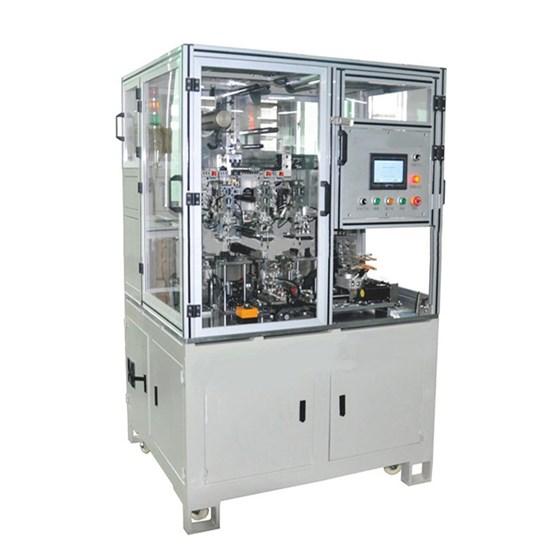
Sodium Ion Battery Stacking Machine
Applications
Batteries produced in a sodium battery fabrication plant serve a variety of applications:
Grid Energy Storage: Large-scale storage solutions for renewable energy sources such as solar and wind.
Electric Vehicles: Sustainable and cost-effective batteries for next-generation EVs with improved safety and cycle life.
Consumer Electronics: Portable electronic devices benefit from low-cost, environmentally friendly sodium-ion batteries.
Industrial Backup Systems: UPS and backup power solutions leverage sodium batteries for reliability and efficiency.
Renewable Energy Integration: Energy storage for off-grid solar and wind installations, particularly in remote areas.
Advantages
Operating a sodium battery fabrication plant offers several key benefits:
Abundant and Cost-Effective Materials: Sodium is widely available, reducing dependency on scarce lithium and cobalt.
High Safety: Sodium-ion batteries provide improved thermal stability, reducing risks associated with overheating or fire.
Scalable Production: Automation and advanced equipment enable large-scale, consistent, and efficient production.
Environmental Sustainability: Reduced reliance on lithium and cobalt makes the fabrication process and batteries more eco-friendly.
Performance Reliability: Precision fabrication processes ensure uniform electrode quality, stable capacity, and long cycle life.
Versatility: Fabrication plants can produce various cell formats—pouch, cylindrical, or prismatic—suitable for multiple applications.
Conclusion
A sodium battery fabrication plant is a critical facility for producing next-generation energy storage solutions. By integrating advanced mixing, coating, assembly, and testing equipment within controlled environments, these plants enable efficient, large-scale production of safe, high-performance sodium-ion batteries. With applications spanning grid storage, electric vehicles, consumer electronics, and renewable energy integration, sodium battery fabrication plants provide sustainable, reliable, and technologically advanced solutions for the growing global demand for energy storage. By combining automation, precision, and scalability, these plants are pivotal for the commercialization and widespread adoption of sodium-ion battery technology.



 réseau ipv6 pris en charge
 fr
fr en
en de
de ru
ru es
es pt
pt ko
ko tr
tr pl
pl th
th


