Xiamen Tmax Battery Equipments Limited was set up as a manufacturer in 1995, dealing with lithium battery equipments, technology, etc. We have total manufacturing facilities of around 200000 square foot and more than 230 staff. Owning a group of experie-nced engineers and staffs, we can bring you not only reliable products and technology, but also excellent services and real value you will expect and enjoy.
Lithium Battery Pack manufacturing Production Line
A lithium battery pack manufacturing production line is designed to efficiently produce highquality lithiumion or lithium ferro phosphate (LFP) battery packs, which are essential for applications ranging from portable electronics and electric vehicles (EVs) to renewable energy storage systems. The process involves several stages from cell inspection through final testing and packaging. Below is a detailed overview of the typical stages involved in a lithium battery pack manufacturing production line as of 2025:
Key Stages in Lithium Battery Pack Manufacturing Production Line
1. Incoming Cell Inspection
Purpose: Ensure all lithium cells meet quality standards before assembly.
Process: Automated systems test each cell for capacity, internal resistance, voltage consistency, and physical integrity. Cells not meeting specifications are rejected.
2. Cell Preparation
Welding/Cabling: Cells are connected together using busbars through welding techniques like ultrasonic or laser welding to form series and parallel connections according to design specifications.
Insulation Application: Insulation materials are applied between cells and connections to prevent short circuits and ensure safety.
3. Module Assembly
Configuration: Cells are grouped into modules. Each module might include cooling mechanisms such as liquid cooling plates or air channels to manage heat during operation.
Connection: Electrical connections within modules are made, and protective casings are added to provide mechanical protection.
4. Battery Management System (BMS) Integration
Purpose: The BMS monitors and manages critical parameters such as state of charge, cell balancing, temperature, and overall health of the battery pack.
Process: The BMS is integrated with sensors and control units within the module or pack to monitor and regulate the battery’s operation effectively.
5. Pack Assembly
Enclosure Design: Modules are assembled into a complete battery pack housed in a robust enclosure designed to protect against impacts, moisture, and dust.
Thermal Management: Advanced thermal management systems might be integrated to maintain optimal operating temperatures, depending on application requirements.
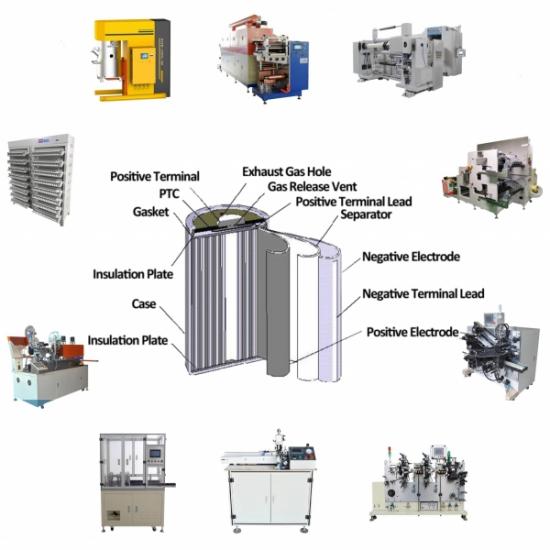
Cylindrical Cell Assembly Plant
6. Testing and Calibration
Initial Testing: Each assembled pack undergoes rigorous testing including chargedischarge cycles, voltage checks, insulation resistance tests, and functional verification under load conditions.
Calibration: The BMS is calibrated to ensure accurate readings and proper management of the battery pack’s operation.
7. Quality Assurance and Final Inspection
Purpose: Verify that the battery pack meets all specifications and safety standards.
Process: Includes visual inspections, electrical testing, and verifying labeling and serialization for traceability and compliance.
8. Labeling and Packaging
Labeling: Each pack is labeled with essential information such as model number, manufacturing date, serial number, and safety warnings.
Packaging: Packs are securely packaged for shipping, ensuring they are protected from damage during transport.
Automation and Advanced Technologies
Modern lithium battery pack manufacturing lines incorporate high levels of automation to improve efficiency and reduce human error:
Automated Guided Vehicles (AGVs) for moving components between stations.
Robotic Arms for precise welding, handling, and assembling tasks.
Advanced Testing Equipment for comprehensive quality assurance checks.
These technologies help ensure the production of reliable and safe lithium battery packs suitable for demanding applications like EVs and largescale energy storage systems. By focusing on quality control and safety, these batteries can perform optimally and safely under various conditions.
Benefits of a Turnkey Solution
Speed to Market: Quick setup without needing to individually design and integrate each component of the production process.
Consistency and Quality: Optimized for efficiency and quality control, incorporating advanced automation and testing technologies to minimize errors.
Scalability: Designed to scale up production as demand grows.
Support and Maintenance: Typically includes support services for maintenance, troubleshooting, and upgrades, ensuring longterm reliability and performance.
This structured approach ensures every lithium battery pack leaving the assembly line meets the highest standards of performance, reliability, and safety, making it ready for integration into enduser products. Whether you're looking to enter the market or expand your existing operations, investing in an advanced lithium battery pack manufacturing production line can significantly enhance your capabilities and competitiveness.



 réseau ipv6 pris en charge
 fr
fr en
en de
de ru
ru es
es pt
pt ko
ko tr
tr pl
pl th
th


